
Reviewed · COMMUNIST BUCHAREST TOURS
Communist Era Bucharest Tour
Step into Bucharest’s Communist past, street by street. This private tour is built around the city’s hard-edged landmarks, from Piața Revoluției to the shadow of Casa Poporului, with a guide who ties the buildings to what daily life could feel like in the Eastern Bloc.
I really like how this experience stays personal. On a private format, you get room to ask questions, and guides like Alina and Claire are known for connecting big history to real human routines. I also like the pacing: it is a focused walk with plenty of short stops, and several sights are free to access so your money goes to the storytelling.
One thing to consider is that you’ll do a moderate amount of walking on city streets, so comfortable shoes matter. Also, this topic is emotional and political, so expect a guide’s perspective, not a courtroom-style verdict on every controversial claim.
In This Review
- Key highlights worth planning for
- The tour’s real value: understanding power through city design
- Price and what you actually get for your money
- Where the walk starts: Manuc’s Inn and a smart meeting point
- Stop by stop: what you’ll see and why it matters
- 1) Piața Unirii and the Unirii fountains
- 2) Bulevardul Unirii, the Socialist Victory boulevard
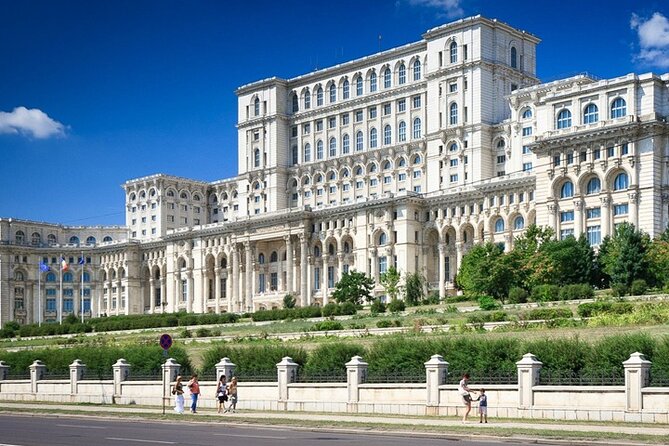
- 3) Casa Poporului, the Parliament Palace at street level
- 4) Victoria Avenue, shopping streets with a political past
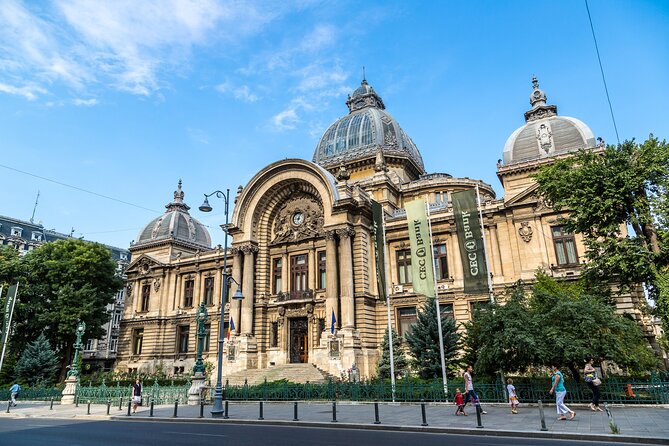
- 5) CEC Bank, the bank of the people during Communism
- 6) Romania’s National Bank, grandeur and institutional memory
- 7) University Square and the Intercontinental Hotel (opened in 1971)
- 8) The National Theatre of Bucharest, a building with changing designs
- 9) Piața Revoluției, the 1989 revolution begins here
- 10) Iuliu Maniu statue, an early figure of resistance
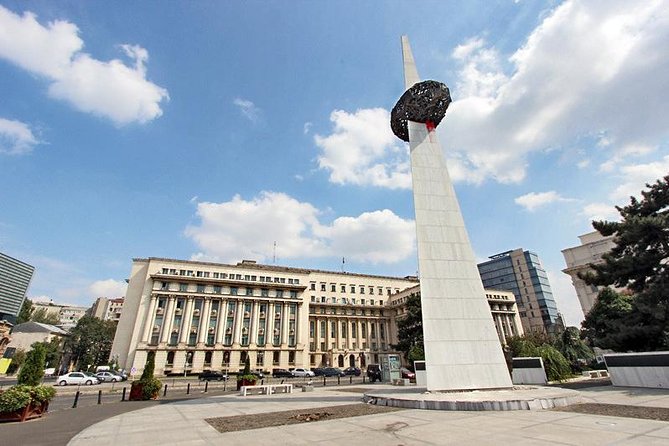
- 11) Memorial of Rebirth, Christmas 1989 victims
- 12) Final return to Manuc’s Inn, a historic finish with photo value
- The guide experience: stories, questions, and the risk of biased history
- How to get the most out of the 3 hours
- Who this tour is for
- Should you book this Communist-era Bucharest tour?
- FAQ
- How long is the Communist Era Bucharest Tour?
- Is this tour private?
- Do I get hotel pickup?
- What is the meeting point and where does the tour end?
- Is the tour available in English?
- Are any admissions included or free?
- Is cancellation free?
- Can service animals join the tour?
Key highlights worth planning for
- Private format with pickup options, so you avoid the usual squeeze of group tours
- Unirii fountains and Bulevardul Unirii, Communist-era planning turned into modern city scenery
- Casa Poporului from the outside, including the story of Romania’s colossal Parliament Palace
- Piața Revoluției photo stops, with the balcony moment and key 1989 memorials in view
- A mix of big monuments and local landmarks, like CEC Bank, University Square, and the National Theatre
- A guide who can adjust on the fly, based on what you want to understand most
The tour’s real value: understanding power through city design
Communist Bucharest is not just a chapter in a book. It is still written into the width of boulevards, the placement of grand squares, and the way certain buildings loom over everything else. That is why this tour works. You are not trying to memorize dates. You are learning how a government tried to shape daily life, identity, and even movement through the city.
I like that the route is built around contrast. You start in a regenerated civic heart, then you move along the long Socialist-looking axis of grand streets, and you end in a square where history broke open for real in 1989. The story lands because you can physically see what the guide is talking about.
Price and what you actually get for your money
At $30.72 per person for about 3 hours, this is priced like a value city walk, not a premium museum binge. The key is what you are buying: a private guide who can explain the why behind what you see, plus a route with free access for multiple stops.
A few practical notes that make it feel good value:
- It is a private tour, meaning you are not paying for a silent line behind a crowd.
- Several stops are ticket-free on this route, so you are not constantly thinking about small fees.
- You can pick a morning or afternoon slot, which helps if you want to pair it with other Bucharest plans.
If you care about context more than checkmarks, the price makes sense. If you only want selfies at the biggest building, you might feel you want a shorter or cheaper alternative.
Still standing, block after block
- Bucharest: Communism and History Guided City Walking Tour★ 4.9 · 918 reviews
- The Real tour of Communism★ 5.0 · 666 reviews
- Life under Communism★ 5.0 · 358 reviews
Where the walk starts: Manuc’s Inn and a smart meeting point
You meet at Manuc’s Inn (Hanul lui Manuc) in the Old Centre. The meeting point is practical because it is easy to find and it is near the action. If you choose hotel pickup, you meet your guide at a centrally located hotel, or you can plan to meet at Manuc’s Inn outside the main entrance on Strada Franceză.
This matters because Communist sites can be scattered across the center. Starting in the Old Centre keeps the logistics simpler and saves you from spending your limited time figuring out transit. The tour also ends back at the same meeting spot, so you do not need to plan a second trip across town just to finish.
Stop by stop: what you’ll see and why it matters
1) Piața Unirii and the Unirii fountains
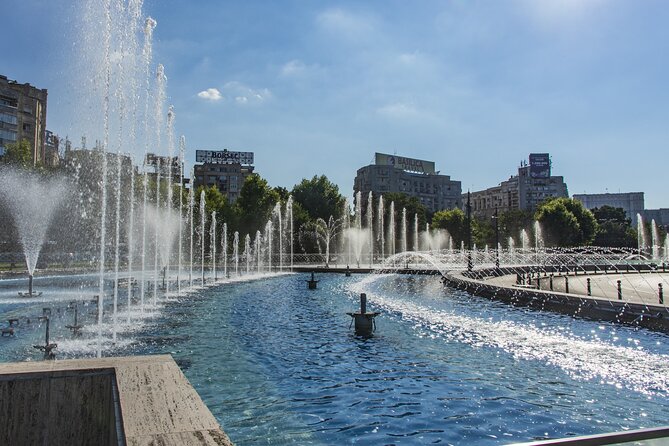
You begin at Piața Unirii, a central square that grew out of Communist-era modernization plans and has since been regenerated into a more modern, lively hub. The highlight here is the newly restored Unirii fountains.
What I like about starting here is the contrast. You are not thrown immediately into the heaviest symbolism. Instead, you see how Communist-era urban planning got repurposed. The square now reads as lively and public, which helps you understand something important: these regimes built spaces for people, even when control and ideology were part of the design.
2) Bulevardul Unirii, the Socialist Victory boulevard
Next comes Bulevardul Unirii, formerly known as the Boulevard of Socialist Victory, sometimes described as the Champs-Élysées-style boulevard of Bucharest. Along the way, you’ll see 17 artesian fountains decorated to represent the four seasons.
This segment is about scale and rhythm. You start to grasp how Communist planning often favored long, straight sightlines and repeated visual motifs. When a guide points out how these fountains were used as a kind of public display, the street stops being just scenery and starts becoming a message.
These pair well with the day you just read about.
- Bucharest: Dracula’s Castle, Peles Castle, & Brasov Old Town
★ 4.5 · 17,858 reviews - Bucharest: Dracula Castle, Peles Castle & Brasov Old Town
★ 4.6 · 10,891 reviews - Bucharest: Dracula’s Castle, Peleș Castle & Brașov Day Trip
★ 4.4 · 6,100 reviews - Bucharest: Palace of Parliament Tickets and Guide
★ 4.3 · 3,182 reviews - Bucharest: Day Trip to Dracula Castle, Peles Castle & Brașov
★ 4.4 · 3,049 reviews
3) Casa Poporului, the Parliament Palace at street level
Then you reach Casa Poporului, the enormous Parliament Palace associated with Nicolae Ceaușescu. Even when you are just passing nearby, it dominates the skyline. You’ll hear why it was built, how massive it is described as, and why it became one of the most powerful symbols of the era.
This is the part of the tour that turns the volume up. It is hard to process this building without feeling its size, so the guide’s job is to give you the meaning behind the scale, not just the factoid. Take your time here, because even a short pause helps you connect the architecture to politics.
Practical tip: bring your phone camera ready, but also look away from your screen for a minute. The building’s impact comes from how your line of sight changes as you walk.
4) Victoria Avenue, shopping streets with a political past
From there, you take a walk along part of Victoria Avenue, a corridor lined with shops. The guide’s focus is on what the Communist era felt like here, and how street life and commerce played into the city’s identity.
I like this stop because it avoids making history only about official buildings. You get the sense of how ideology can sit next to everyday life. A shopfront is not a monument, but it can still live inside a larger power structure.
5) CEC Bank, the bank of the people during Communism
You also pass the CEC Bank, described as the bank of the people during the Communist years. This is a smaller stop, but it is the kind of detail that makes the whole tour feel grounded.
Banks sound dry, until you realize they reflect who held power over savings, wages, and ordinary financial survival. When the guide frames a building like this as part of everyday systems, it turns into a practical lesson about how governments reached people without asking for speeches.
6) Romania’s National Bank, grandeur and institutional memory
After that, you see the National Bank of Romania, and you’ll hear about its history. The emphasis is on grandeur, but the better takeaway is how institutions used architecture to signal stability and authority.
If you pay attention at this stop, you’ll notice how different official buildings in the city share a common language: order, permanence, and scale. That shared visual language is one way a regime tries to make itself feel inevitable.
7) University Square and the Intercontinental Hotel (opened in 1971)
At University Square, you’ll see the oldest and largest university in Bucharest and hear the story tied to the Intercontinental Hotel Bucharest, which was completed and opened in 1971.
This mix of academia and hospitality is interesting because it shows how the city served multiple functions. Universities reflect long-term identity. Hotels often reflect international visibility and the image a city wants to show. Put together, the stop gives you a more rounded sense of what the Communist period could prioritize.
8) The National Theatre of Bucharest, a building with changing designs
Next, you pass by the National Theatre of Bucharest. You’ll learn about its history and the fact that it has undergone many design changes since its early days.
This stop is less about one dramatic moment and more about continuity. Even under political change, cultural landmarks adapt. Watching the guide connect architecture to shifting eras is a good reminder that culture never stays frozen, even when regimes try to manage everything else.
9) Piața Revoluției, the 1989 revolution begins here
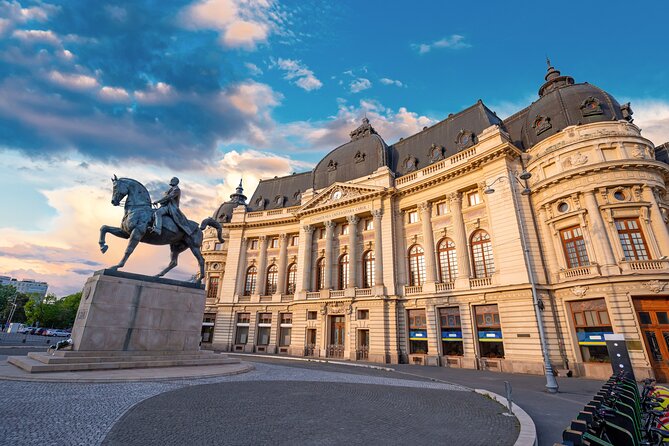
Now you reach Piața Revolukiei (Piața Revoluției), the central square tied to the famous 1989 revolution. This is one of the most powerful segments of the route because you get a list of memorials and key sites in one walking sweep.
You’ll see:
- the area where the revolution started
- memorials commemorating the events that changed Romania
- the balcony where Nicolae Ceaușescu made his final speech
- the former headquarters of the Communist party
- the Monument of National Rebirth
- King Carol I’s equestrian statue
- the University library
- and more, in the immediate area
This is also where the tour feels photo-friendly. You’ll have time for excellent photo opportunities, but again, it helps to balance pictures with attention. Let the guide’s storytelling connect which building is which and why the square mattered.
10) Iuliu Maniu statue, an early figure of resistance
Then you stop at the Iuliu Maniu statue. You’ll hear about the three-time prime minister and his struggle in the early years of Communism.
This is a good pivot from 1989 back to earlier political pressures. It reminds you that Communist control did not start with one day. It involved long conflict with political figures.
11) Memorial of Rebirth, Christmas 1989 victims
You’ll also see the Memorial of Rebirth, a 25-meter structure commemorating the struggles and victims of the Romanian Revolution of Christmas 1989.
The height here is the point. The guide’s role is to keep the monument from becoming just a tall structure. You want the story of why this memory was built into the city.
12) Final return to Manuc’s Inn, a historic finish with photo value
You finish back at Manuc’s Inn, a historic building described as built for the people of Bucharest by the people, over 100 years ago, with beautiful gardens and strong photo opportunities.
Ending here is smart. After standing under heavy symbolism, you get a calmer, historic setting to reset and plan your next Bucharest move.
The guide experience: stories, questions, and the risk of biased history
Many guides on this route lean hard into personal storytelling, including accounts tied to growing up under Communism, not just official timelines. I like that approach because it helps you separate what was said from what was lived.
Guides like Alina, and also Claire or Clare as named in prior experiences, are described as engaging, animated, and willing to clarify. The tone tends to be balanced, including the good and bad sides, and you should expect your questions to be taken seriously.
One caution: Communist history is intensely contested. A minority of feedback raises concerns about interpretation and historical accuracy. So, if this topic is close to your heart or you’re building a strict personal record, ask direct questions. If something sounds off, say so politely and get the full explanation. A good guide will welcome that.
How to get the most out of the 3 hours
This tour is built for walking, so set yourself up for success:
- wear comfortable shoes
- have your camera ready but don’t spend the whole time filming
- bring questions, especially about everyday life versus official stories
- if you want deeper context, tell your guide early, since the tour can run long when conversations keep going
Also, if you’re short on time in Bucharest, this one is a strong pick because it strings together the city’s most important Communist-era markers without requiring separate museum visits.
Who this tour is for
This tour is perfect if you:
- want a street-level understanding of Communist Bucharest
- like guided history that connects politics to city design
- want photo stops at the 1989 revolution sites, including the balcony area
- prefer a private format where you can steer the questions
You might not love it as much if you:
- only want a single landmark like Parliament Palace and nothing else
- dislike political history or find it too heavy for a walking afternoon
- expect a museum-style, citation-heavy approach to every controversial claim
Should you book this Communist-era Bucharest tour?
If you want a practical, local-feeling way to understand how power shaped the city, I think you should book it. The private format, the tight 3-hour length, and the mix of Unirii fountains, institutional buildings, and Piața Revoluției give you the kind of coherent story that is hard to assemble on your own.
Before you go, decide what you want most: the architecture and symbolism, the daily-life angle, or the 1989 turning point. Then ask for that focus. If you do, this is the sort of tour that can leave Bucharest feeling personal, not just photographed.
FAQ
How long is the Communist Era Bucharest Tour?
It lasts about 3 hours.
Is this tour private?
Yes. It is a private tour, so only your group participates.
Do I get hotel pickup?
Pickup is offered. You can meet your guide at your centrally located hotel, or meet at Manuc’s Inn outside the main entrance.
What is the meeting point and where does the tour end?
You meet at Manuc’s Inn (Hanul lui Manuc), Str. Franceză 62, Bucharest, and the tour ends back at the meeting point.
Is the tour available in English?
Yes, it is offered in English.
Are any admissions included or free?
Several stops are listed as free, including parts around Piața Unirii and Piața Revoluției, and other nearby sights on the route.
Is cancellation free?
Yes. You can cancel up to 24 hours in advance for a full refund.
Can service animals join the tour?
Yes, service animals are allowed.
Just Added: New Tours From Bucharest
- Bear Watching in Transylvania 2-Day Tour
- National Village Museum and Comana Adventure Park
- Half Day Tour in Bucharest
- From Dracula to Ceaușescu- Romanian Terror Stories tour
- Full-Day Private Tour of Brasov City and Peles Castle from Bucharest
- Bucharest: Tour The Wine Road, 2 Boutique Wineries in 1 Day
- Bucharest Ceaușescu House Parliament Palace &Village Museum
- Full-Day Private Tour of Bucharest and Mogosoaia Palace
Communist Bucharest Tours, compared.
Parliament, Ceausescu House & Village Museum Tour
Read our review →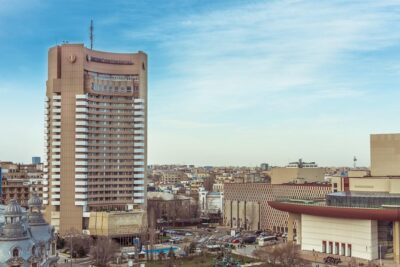
Bucharest Essential Tour: Old Town, Calea Victoriei & Communism
Read our review →
Communism in Bucharest – Landmarks, Museum & Communist Appetizers
Read our review →
Browse the lists this tour appears in